Yes, it is about that. But here’s the 100% truth: the book is not ALL & EXCLUSIVELY about packing small and playing big. The topics covered in the book, like …. Your Biggest Prop Avoiding Visual Confusion Comedy Crutches The Big Free Props Available At Every Venue Fire Replacement
…all these tools help a show no matter how big or small it packs.
Could they be more even more important to the performer whose props fit in a carryon bag? Probably, but they are very important to every performer.
Which leads to the topic of this post …
The POWER of PACE & SPACE
Miracles. Are. Not. Rushed.
A deliberate, unrushed pace can visually and mentally focus an audience on a small handheld prop, like a playing card. The right pace, slowed down and sped up at the right times, can give something as potentially uninteresting — like the identity of a playing card — HUGE importance. The wrong pacing can bring little more than, “Oh, the four of diamonds. That’s cute.”
“But the magician wasn’t anywhere NEAR me or the cards!!”
When I perform the classic cards across with envelopes with two spectators, I have them at least eight feet from each other. When I performed bill in lemon, the lemon was sitting up to 20 feet from me for most of the show. When any number of magic greats perform a prediction (like Copperfield’s classic Graffiti Wall Prediction or Penn & Teller’s great Bottle Prediction) the prediction is very high in the air, sometimes up to the edge of the proscenium arch.
Would the method of these routines change if the volunteers, lemon, envelope, or bottle were closer?
No.
Would they be less impressive to a lay audience if things were closer?
Yes.
Before we move on, ask yourself, “Where in the magic I already do can I better use pace & space?”
Pace & Space are among the tools that elevate tricks into miracles.
And that brings me to Dixon Magic’s newest release.
Card at Any Number For Close-Up For Stage Born in the work of an early 20th century master magician Routined for maximum impact
I recently released Trip To The Clip 2.0, a natural routine for EDC (Every Day Carry).
With that in mind, I’ve been thinking more about magic EDC. Here are a few of those semi-rambling (but hopefully useful) thoughts. Some of these are explored in the Trip To the Clip video.
Purposes
The purpose (or at least my purpose) for magic EDC isn’t to shoehorn magic into less than ideal scenarios. It’s not even to always be ready to perform, although some of these suggestions in this post, like be able to magish with quarters, will do that.
To me, magic EDC is being ready to perform in situations where it’s beneficial to you and the possible audience. So if I know I’m going to in a situation with that possibility, I bring those few things necessary.
They’re pockets, not saddlebags.
I look at some of the pics people post of their EDC and think, “Whoa. That’s a TON of props.” As in a dozen props. Listen, if that’s you, well …you be you. That’s not me. And I say that not to pay polite lip service when I really think something much more negative. Nope. I sincerely mean, “if you want to carry that much, good for you. I prefer not to carry that much stuff.”
They’re pockets, not magic shops
Sponge bunnies are a working staple of thousand of pros, yet for EDC I can’t get past the oddness of people thinking, “That’s a “grown a** man who carries around tiny bunnies.” Listen, if you DO carry around sponge bunnies on a daily basis, I’m sure you bring some joy to folks, but I’ll still pass.
To be clear, I am not talking about a strolling or close-up gig. I’m talking about EDC.
Don’t just think EDC. Think EDA.
There are things that are magic friendly that exist in the world around us every day. These things are Every Day Available. Meaning, if you’ve never performed Three Fly with three Ritz crackers, forget me asking if you’re a magician. Instead, ARE YOU EVEN ALIVE???!! HA!
One of my favorite memories of this sort of thing is from thirty years ago when I noticed a loose thread hanging from the jacket of a woman I was dating. It took me about 5 seconds to quickly ready a Gypsy Thread. I performed it for her. She wasn’t given to foul language, but as the thread restored she just looked at me and said, “What the %^&*. How? HOW??!!”
I’m certain that 90% of the impact came from the improvised nature of it. And the same impact comes when you perform Chink-A-Chink with sugar packets.
Unlike birds, quarters are real.
Quarters are better than every day carry, as they are every day available. “Excuse me, may I have change for this bill in quarters?” Now you’re good to go.
There’s a ton of ungaffed coin routines that work very well with quarters. You don’t always need half dollars. Get into some of the classic David Roth routines and you’ll find some gems that work well with quarters. Eddie Fechter’s coin work is another great source. Spend a few minutes with half a dozen quarters to get used to the size and you’ll see what I mean.
The jumbo coin that is not a jumbo coin.
I’ve done the Slydini/Roth One Coin Flurry with a jumbo coin finish for decades. For slightly fewer years, I’ve performed it with a surrogate jumbo coin. This originally appeared in my blog back in August, but I’ll save you the trouble of clicking by reposting it here:
*******************
In the original routine, a half dollar (or for EDC, a quarter would be fine) vanishes and reappears several times, then transforms into a jumbo coin as it lands on a spectator’s palm.
Here’s the great coin master David Roth performing it. One difference is he does the large coin appearance in his hands, not the spectator’s hand.
My EDC version:
Coins are something I carry every day. A jumbo coin? Not so much. As you might expect from a guy that wrote a book on packing small, playing big, and living large, I’m not a fan of carrying a bunch of extra stuff in my pockets just for the chance of EDC amazement. So if not a jumbo coin, what??
I want the coin to transform into that is: 1) the right size 2) makes theatrical sense 3) is something I usually carry
I use my wallet I currently I use my bill clip from Trip to the Clip
The scripting is simple enough, as this routine is fun, quick eye candy, not Atlas Shrugged. “Fifty cents here. Gone. Fifty cents. Fifty cents. (Wallet) Fifty bucks.”
For deception’s sake, try not to put your wallet in the same pocket you stole it from. And to be clear, this works with a hip pocket wallet, not the larger wallets, like the classic Seabrooke or Kaps wallets.
If you want to learn the Roth routine, track down a copy of David Roth’s Expert Coin Technique by Richard Kaufman. I’m sure there are other sources on video, but my copy of the book was literally 12 inches from me as I typed this post.
***********************
Speaking of borrowing a handful of coins …
I won’t tip it here in this public page, but there’s a great routine where you write down a prediction. A dozen or more coins are dumped on a table and the tails up coins are set aside. The remaining heads up coins are gathered up, dumped on the table and the tails up coins are set aside. This leads to one heads up coin left. Say, it’s a 1989 nickel.
Your prediction reads 1989 nickel.
This can play large for a small group. Use a glass to shake the coins to add the element of noise. Have several different participants shake the glass. Each shake adds a little more impossibility and drama.
You know the work on this, so consider this a reminder of a classic you may have forgotten.
The Hoy Book Test
You pick up 3-4 books off the shelf your friend’s house. A little magician’s choice happens. A dash of showmanship. Boom. You’ve read a mind from across the room.
Cards Are Good EDC
A plain, ungaffed deck of cards can obviously do wonders. Hundreds of wonders. Takes up little pocket space and, unlike bunnies, doesn’t look odd. To be blunt, they often look cool.
Someone asks you to “do a little something.” You demur. “Please?” “Well, OK.” You take out a deck of cards. “I carry these with me sometimes.” You remove the cards from the case and absent-mindedly pop a one-handed shuffle. “OH, THIS IS GOING TO BE SOOOO AWESOME!!!!”
Yep. Cards are cool.
On that note, here’s a routine that combines cards with another classic, Patrick Page’s Flash Cash (modified for EDC). Have it in your pocket and you’re always ready to blow some minds.
I posted this on my personal Facebook page April 2, 2013. I offer it here, eleven years later, unedited, as it still rings true to me.
************
Magic needs a more refined nomenclature.
I recently had a friend ask me about some magicians who represent themselves as “comedy magicians”. I went online and watched their videos.
Apparently promiscuous use of the term “comedy magician” is more popular than ever. Just because an act gets a few laughs, it’s not a comedy magic act. What is it? It’s a MAGIC ACT THAT GETS A FEW LAUGHS. Try getting “just a few laughs” with that act in a comedy club. There’s a name for that experience. It’s called “bombing”. If a so called comedy magic act is not getting multiple laughs per minute, virtually every minute, it needs a new label. It may be a wonderful act, but it’s not a comedy magic act and the performer is not a comedy magician.
To become an actual comedy magician a particular kind of dues have to be paid, whether it’s bombing early in a career or sweating the exact wording of jokes throughout a career. Adopting the name without paying those dues devalues the work of those who have.
Buying a few “comedy magic” routines doesn’t do it, either. About 20 years ago I bought a chair suspension. I called a good friend and talented magician, Nick Carifo and told him, “Hey, Nick, there’s a new ILLUSIONIST in town!” Of course, I was kidding. Buying a chair suspension no more made me an illusionist than buying (fill-in-the-blank) makes someone a comedy magician.
Today’s post is sponsored by The Kids Know Best, my book on family/kid show magic:
Today I spoke/performed at my second grade son’s Career Day.
I did four twenty minute sessions. About twelve minutes of tricks, followed by a talk and some career day oriented questions.
FUNNIEST PART: After the second session I heard a student loudly say this in the hallway outside the classroom:
“This is fun! There’s a WHOLE magician in there!”
MEMORABLE PART: Getting to perform in front of my son’s friends and make him proud of his dad’s odd career path.
EDUCATIONAL PART: Kids LOVE to help the magician. And that means kids of all abilities and challenges. Back when I was performing 250 school assembly programs a year, I knew what routines in my show were handicap accessible, and with different degrees of ability in mind. I didn’t even have to change the material. A little forethought, preplanning, and adapting on the fly is all it takes.
One of those opportunities happened this morning.
An 18 inch diamond silk vanishes by the usual method. I walk towards a young girl in the front row. “I thought I remembered you from the Super Secret Magician Meetings! Please hold out your left arm.” She does so. I reach in her sleeve and pull out about 3 inches of silk hanky.
Her head whipsaround to look at the rest of the audience as if to say, “ARE YOU SEEING THIS, TOO!!???” The rest of the hanky comes out. Everyone clapped, laughed, and cheered. She was elated. The kid got to be the star. She gets to feel the other kids cheering her on and being envious of her. The entire audience feels the warmth of the child’s happiness.
If the only benefit to this material choice was making this little girl happy, that’s more than enough.
But there’s more than that. If you’re an emotional softy like I can be (and I’m not the only one), seeing a little girl with challenges get to be a rock star in a magic show PLAYS HUGE. It will be remembered long after any other moment in the show.
It doesn’t require cases of props. It’s doesn’t require packing big props. It requires the right decisions and preparations. Once done, you’re not only playing big, you’re playing kind.
If this kind of thinking resonates with you as something you’d like to see reflected in your shows, you can learn more about in my book, The Kids Know Best.
Shortly after my book, The Show Is The Mother Of Invention, How to Pack Small, Play Big and Live Large came from the printer I realized I could have added one more strategy for playing big from a carryon case. And I kicked myself because it’s something I use in my own work.
Doh!
So I’ll talk about it here.
It packs small.
It is invisible until it’s used.
In fact, it doesn’t need to be packed, as once you have it you have a hard time getting rid of it.
It’s called SKILL.
Skill is what turns a small prop like a deck of cards into an impressive manip segment.
To put more of a point on this, I’m not talking about the kind of skill that goes unseen, like our magic secrets. I’m talking about a particular skill subset and type of routines where the audience openly can appreciates our skill — or at least thinks they are.
When a magician performs a solid book test, the audience may be baffled, but there’s usually not a perception of this kind of skill. The audience is simply amazed.
But when a magician performs a well-routined card manip segment or …
a great coins to glass routine or …
a juggling type routine like the hoop and glass routine or …
a mental skill like a memory demonstration (real or otherwise) or …
a magic square (another mental skill)– like Reign Man — currently ON SALE
…the magician is showing skill.
In his fantastic lecture notes, the late great Denny Haney talked about the placement of a skill piece later in the show. In the context of his writing he was explicitly referring to a manip segment, experience has shown me Denny’s wisdom applies to other skill-centric routines, too.
The power of placing the skill set later in show is brilliant. The audience’s appreciation for the performer is so much greater because they already know and like the performer. Denny was so great.
This has crossover value to pack big & play big goals, because few things pack smaller than skill.
I recently tried a new ending for a routine I’ve been performing for over a year.
The routine has become solidly funny and very much in my performing character’s wheelhouse. The routine is similar to a multiple selection routine with cards, in that an ending sequence isn’t needed, but it certainly is a plus. A good ending can certainly help and it puts a bow and applause cue on the finish.
My old ending was good …but not good enough. To repeat, the routine doesn’t need an ending segment, but I’m convinced the right ending would bump it up several notches.
So like you read, I tried a new ending. I was confident going into it. “Yeah, this will SCORE!” I thought. I got a little artsy and craftsy, building a flap card for the ending gag. Bounced the idea off a trusted magic. buddy.
“Yeah, this will SCORE!” he said.
At this point, I was looking at a TWO SCORE guarantee!! My magic buddy and me!
Show time arrives.
The new ending (a visual gag) probably took twenty seconds of stage time.
And … It wasn’t as good as the one that wasn’t good enough. In fact, to be honest, it sucked a little. Thankfully, it was sandwiched between strong laughs and interaction in the routine that lead up to it and the routine that followed it. But that new gag? Crap.
Thank YOU, SNL reference of yore.
AND THAT’S PART OF THE PATH TO GETTING BETTER
Eventually, I’ll figure out the ending for this routine. In the meantime, I’ve abandoned the semi-good and not-good ending. Quality of performance over quality of minutes. Every. Single. Time. It’s currently a very well-received routine, but I still want that last piece of the puzzle …some day …must keep trying …
So what’s my point?
If you read my books The Show Is The Mother Of Invention (the reprint arriving from the printer any day now) and my latest book,The Kids Know Best (in stock and shipping), you KNOW how much I value writing magic routines.
With that in mind, I wanted to address a hurdle people have to overcome with introducing newly written material in their show. Ready?
Quit being afraid to die for a few seconds. (Comedy death is temporary. Great jokes are immortal.)
Bounce the new line or brief bit off some trusted magic or comedy confidantes. This is wise, but is never surefire.
Until you know it will play well, put the new lines in for a few seconds at a time. If it kills, great! If it semi-kills and shows promise, fine tune and try again. If it dies a quick death, get over yourself, learn from it and try again. If you have sandwiched the new untested seconds between tested and proven seconds of material, you will notice the death much more than your audience, if they notice it at all. Trust me. This is the path to being a better performer.
Is this fun? Well, to be honest, yes. But it’s only fun if you kill your ego and you embrace it. The greatest comic that ever walked the earth,Norm MacDonald, was known for his wonderfully eccentric version of living this. If he killed in a show, afterwards he’d stay backstage and play poker with the other comics. If he died — and especially the highest (lowest?) level of dying, known as “walking a room,” where people walked out of the show — he would do a meet and greet with every remaining audience member as they left. Hail Norm.
What is the alternative?
Not creating and not writing leads to being a collective clone of other magicians. A collage of others comedy conjuring. Ugh.
This doesn’t mean it’s a bad idea to perform classics. This doesn’t mean it’s a bad idea to perform material that is sold by other performers, in fact, that’s often a GREAT idea …hint, hint … visit our store.
It means it’s bad idea to parrot classics. By parrot, I mean doing verbatim performances. Both my recent books have more to say on writing and getting new routines in your show, but let me sum up this post with this summary. Best read in Mr. Miyagi voice.
Killing the ego & dying on stage is the only way to live forever.
Until Next Time,
Doc Dixon
PS: As always, be sure to visit the store. Here are the two books I mentioned in the post.
PS #2: I just received great news from Joe Diamond, talented mentalist and recent Fool Us performer. This is the kind of reaction that Psychic Cents receives!
I posted this on my personal Facebook page a few days ago:
For Magicians: At a country club gig tonight. People seated to right and left, no one in front. What’s this mean? Gonna be a good post at Dixon Magic.
And this is that post. (And I’ll end this with a Facebook post from nine years ago.)
I arrive for the gig. It’s an after dinner stand up show for about 100 people. My contact tells me, “In the past day we had thirty more people sign up, so we had to change the set up. It’s different than what we discussed.”
Like the “dance floor of death,” the “barbell of death” is one of those classic seating nightmares.
Here’s a rough idea of the layout of the event. Looks a little like a barbell, doesn’t it?
People seated to the left. People seated to the right. Me, looking straight ahead at an empty (and well stocked, thank you for asking) bar. No riser.
Before I get into how it worked out, let’s set a few ground rules for the discussion:
Rider Schmider
“The best laid plans of mice and men often go awry.” You can have all the rider discussions you want, but the bottom line is making the show a success. In this situation, the client (who was a gracious and agreeable) was hit with the surprise of adapting to thirty percent more people a day before the dinner. He did the best he could.
Yes, a rider and a detailed pre-event discussion can go along way, but when the rubber hits the road (or the prop case enters the room) you can’t get go back in time. You have to play the ball as it lies.
Be Kind & Patient
Primadonna – pre-muh-don’-uh (noun) 1. Performer who won’t get hired again.
So what did I do?
There were stools in front of the bar. There was room for two rows of ten chairs in front of me. I suggested chair moving to the client before the show started and, surprise, we were on the same page. Between the bar stools and chair moving, I can have about a third of the audience in reasonably good position.
But how to get the people there?
While people were arriving and waiting for the meal to begin, I walked up to several of the tables and introduced myself and chatted. I placed a priority on the tables that would be farthest from me. Before I left each table I said:
“By the way, because the layout of the room is a bit challenging, we are inviting a few people to come up and sit in chairs that will be up front. And the reason I’m asking you is that we are only asking the most attractive people.“
The reaction was pleasant laughter. If they moved (as several did) great. If they don’t move, at least we’ve had a pleasant connection before the show. The comedy pump is primed.
Then ten minutes before my show, the host invited people to come up front.
It worked.
And there was a surprise benefit. The group that came forward were self-selecting. They were the most eager to be close to the fun. And they were fun.
OK, so the audience is seated as well as possible in this barbell-shaped setting.
What else helped?
The biggest visual element of my act is ME. My face. My movements. Easy to see. The audio element is the script and the situations created. A script is something that is heard, not seen. What needed to be seen in the act was easy to see in this challenging setting.
Related to that, I’m not doing a manip act. Again, the visual element is made up of myself and the volunteers.
Sometimes I do the chop cup on stage. Not for this gig. Nothing that is a table tied routine like the cups.
I am 6’4″. Being tall helps.
I made sure I played wide. Several times I might have looked like I was watching a ping pong match. I walked into each of the side sections (lobes?) for some of the bits, trying to do all I could to maximize engagement in a challenging setting. I addressed people from the deep sections of the audience.
In one of my routines I have two people come up and sit in chairs. In this show they sat on barstools. This routine being the longest one in my show, the bar stools were a big plus.
I was booked to do a 45 minute show and did, but I had props for about 80 minutes of material in my case. It’s nice to have options.
So what would not have helped?
Complaining. Saying things to the booker like, “But we said …” Saying things to the booker like, “I can’t do the show because …” Telling anyone to move. I asked them with them with a flattering joke. Calling attention to the challenging seating during the show. Shoehorning in material (like the chop cup mentioned earlier) that had no chance of working.
Summary
This is far from the worst room layout I’ve had to deal with. Once the show started, it was very manageable. And I’m sure you’ve probably had worse, too. I get that. I’m just the old man here sharing a road story.
Do what you can before the show to bring the seats in closer and to make the show a success. If this involves furniture moving, just do it. My client is the client. Not the room. Not the venue. Move seats. Moving chairs is better than a great classic palm.
A related situation happened to me a few years ago. Nice proscenium stage. Great tech. Big room. Oh, and the front row was 10-20 feet away. Ugh. Thankfully, the chairs were movable. So having arrived about four hours before show time, I moved dozens of chairs from the back row to the front row until the front row was an acceptable distance from the stage. While I moved the chairs the meeting planner didn’t think my furniture moving was necessary. After the show she said, “You were right.” Good for her. She got it. I don’t write that with an “I told her so” attitude. I write that with a “It’s not her job to know why the chairs should be close. It’s mine. It’s her job to allow me to do the best work I can, even when she doesn’t completely understand.” And she did. Kudos.
It’s about the show, not the “I told you so.” Don’t spend a moment saying, “But my tech rider said …” Could that be a conversation for after the show? Maybe, especially if you still have a great show. But before and during the show that energy is better spent dealing with the challenges in front of you.
Finally, as I finish up this post let me say there are times when you have to be firmer than I have written about on these pages. This is especially true when it’s suggested you do anything that involves risk — “I know it’s a low ceiling, but we still want the fire eating routine” — or when it will ruin the entire how — “Set up in front of the giant wall of floor to ceiling mirrors.”
Here’s a Facebook post I wrote about nine years ago, when I was feeling some rant vibes.
A rant for my fellow magicians. Forgive me, this one’s been a long time coming and I’m writing it as a reminder to myself as much as anyone else…
I see/hear/read magicians whining about less than ideal show conditions.
*sigh*
It’s kind of like a plumber complaining about a pipe that’s hard to reach. So what? Do your job. It’s not the pipe’s job to make the plumber’s job easier. And the homeowner doesn’t want to hear the plumber whine about the pipe. The homeowner has one job: pay the plumber. The plumber has one job: to fix the sink.
If you’re a plumber, fix the sink. If you’re a performer, rock the room.
Yes, I know bookers can fail in the critical ways — bad sound, bad lighting. This ain’t my first rodeo. But if we take the approach of “I will overcome,” we have a better chance of delivering the goods than taking the pretentious prima donna approach of “oh, the pain”. (Those last 3 words are best read in the voice of Dr. Zachary Smith.)
If you can’t do the job, don’t take the gig. Or put more eloquently, when the show conditions are sub par or even subterranean and you ask yourself, “What can I do? What can I do?” look at what one wise man told this singer when he started whining.
Until Next Time,
Doc Dixon
PS: As always, be sure to visit the store. You’ll find several routines, like Invisible Knots and Maweege, that ever kill in “barbell shaped rooms”
↓↓GET YOUR HANDBOOK! IT’S FREE!!↓↓ ^^GET YOUR HANDBOOK! IT’S FREE!!^^
.
.
Posted inUncategorized|Comments Off on When The Room Is Shaped Like A Barbell
Recently a magician friend posted a performance video online that used the Pass in a visual way. By visual way, I mean the selection was placed face up in the middle of the deck and visually arrived on top. I posted a comment along with the video you see below.
I commented, “As I begin to type this it occurs to me I’ve been doing the Pass nearly 40 years … While rocking the wrist isn’t bad, I don’t think it is preferred for a *visual* goal. When you rock the wrist on a visible pass revelation, you are taking the top out of the deck out of view for a moment– the opposite of what you’d want for a visible revelation.
If you want to showcase the appearance, it’s preferred to let the top be seen, do the Pass, and the selection appears.
I shot a quick video of a Riffle Pass. This isn’t as good as I used to do it. It illustrates the point about letting the top of the deck be seen.
Now here’s what surprised me:
In the day since posting that comment and five second video, I received many messages asking for pass tips, instruction, etc. Yes, I have put in some road miles with the Pass. Put in the miles, you’ll get there, too.
Best,
Doc Dixon
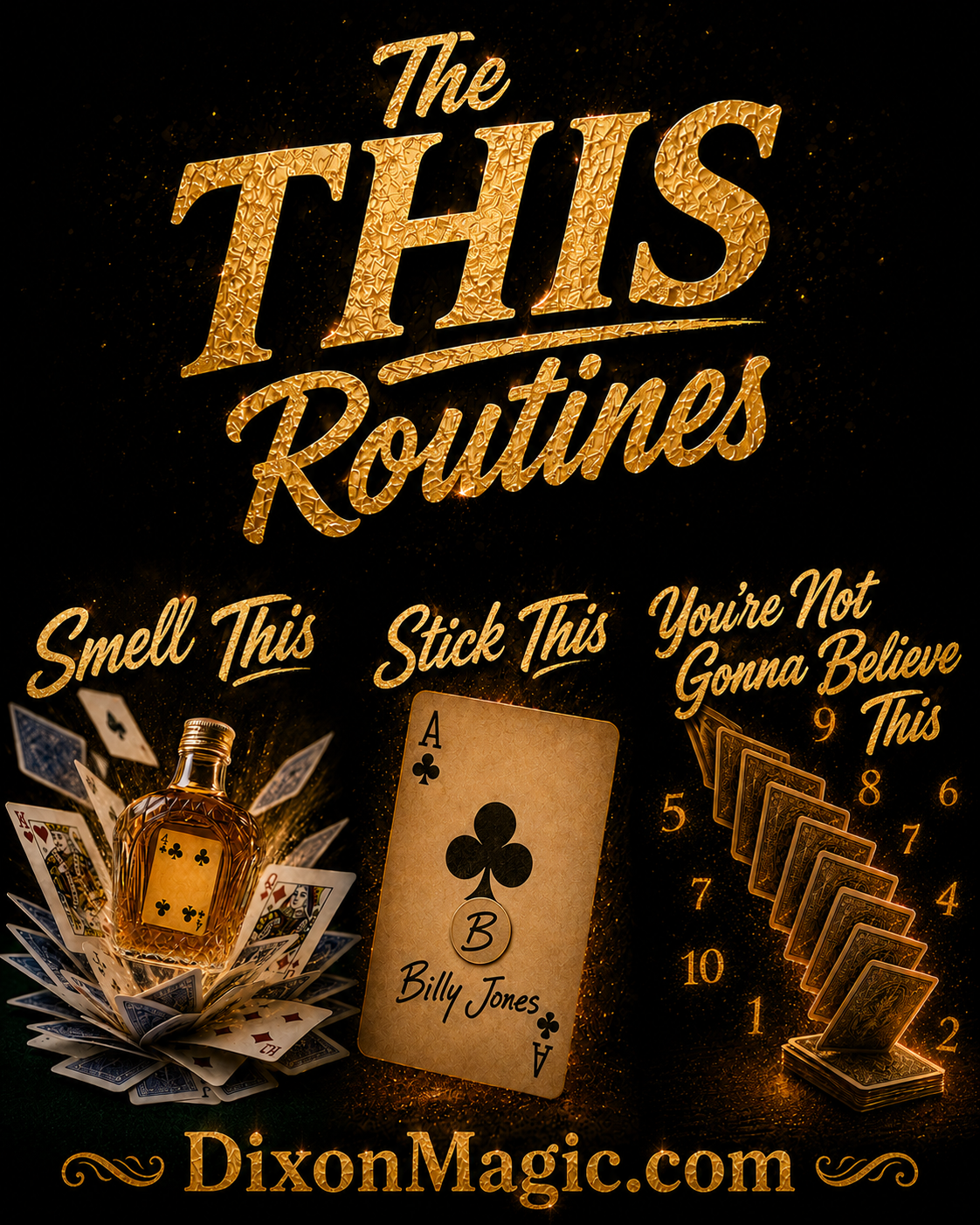
PS: UPDATE AUGUST 2026 I’ve released The THIS Routines. In the teaching video I’m taking a deep dive into pass instruction. This will not only improve these routines, but a well done pass is like a universal magic wand (pun very intended) in that it can benefit nearly all of your card magic.
I can definitively answer this. Why? Because I made up the term. HA! Yes, making up words and then using them like they are an established “thing.” This kind of evil genius is usually confined to politics, but why should government employees have all the fun?
A comedy anchor is — and remember, I made up the term so brace yourself for some arbitrary defining — is someone in the audience you can go back to for callbacks, comedy, and interaction. Once in place, they are a reliable resource like an anchor is to a ship. Despite the arbitrary definition, a comedy anchor is very much a real thing.
EDIT: After a chat about this post with a magician friend, I want to make clear I am not talking about a running gag, though this is similar. A comedy anchor is (and once again, I get to define it lol) an audience member that can be referenced and interacted with multiple times throughout a show. While that’s similar to a running gag, it’s not the same. This person — the comedy anchor — becomes a character in the show.
Let me give you a real life, improvised example. I said to a woman in her 70s in the front row, “May I ask your name?”
Instead of telling me her name, she replied, “You may.” This got a big laugh from the rest of the audience, as her tone made it obvious she was messing with me.
I let the laugh ride, then immediately replied in tongue in cheek rant mode, “So, how long have you been an attorney? Or here I am, trying to be polite, and Her Royal Highness up here, is ‘oh, a peasant!” I know this reads dry in print, but it was very funny. And very importantly, the woman thought it was funny, because we were playing with each other.
I referred to her teasing a few times throughout the rest of the show. She became a comedy anchor for that show. My show was better because I had a comedy anchor.
What makes a good comedy anchor?
The anchor is established EARLY in the show. That means more opportunities for you to smartly use (not overuse) the ploy throughout the show.
It’s based on good-natured fun, NOT harshness. In the example I gave it was self-evident to everyone that I liked her and she liked me, so when I referred back to the interaction, there was no downside or meanness. If she was a heckler or awkward, then referring back to it makes the audience revisit the prior unpleasantness.
A good anchor is best when they WIN at the end. Late in the show while another spectator on stage was helping me, I leaned towards the anchor and said, “I apologize. He’s giving me a much harder time than you did.” Both spectators laughed. Winning at the end gives the anchor’s participation a bit of a story arc throughout your show.
Comedy anchors are best when PLANNED. The example I gave was unplanned, as I obviously can’t rely on that spectator response (“You may.”) in each show.
But what if you did plan a comedy anchor for your show? What if a comedy anchor was a resource that was scripted into your show? What if the callbacks to the comedy anchor were also scripted into your show? THEN YOUR SHOW WOULD BE MUCH, MUCH BETTER.
Two Ways to Get Your Comedy Anchor
#1 Start writing.If there’s a running theme in my books The Show Is The Mother Of Invention andThe Kids Know Best, it is the value of writing. Knowing is half the battle. If you know the value of a comedy anchor, you’re half way there to having one.
#2 Get Invisible Knots. (Yes, shameless product pitch.) My rope routine, just released, has a built in comedy anchor in the script, and will help you create other comedy anchors in your show.
Until Next Time,
Doc Dixon
PS: Surprise bonus sale! If you go to Maweege, you’ll see there’s a sale on that, too!Maweege can incorporate a great callback to the comedy anchor established in Invisible Knots.
I would reply to that definition by saying, “Excessive? Not if the audience loves it!”
I spent a good portion of my holiday season performing Christmas themed shows for a decade long client of mine. In every single show I performed Snowstorm In China.
No, I didn’t say, “It never snowed when I was a child.” (That’s David Copperfield’s script.) No, I didn’t bring out a snow globe. (That’s the genius of my friend, Peter Samelson.)
My script centered around a traveling the world as a performer after growing up in a small steel town only a few miles from the venue. The script is tailored for the venue, and has laughs, interaction, and, yes …
It has schmaltz.
I apologize for nothing.
If the decision to perform Snowstorm In China rested in my preferences, I would have stopped long ago. If the decision to perform Snowstorm In China rested in the trick itself, I would have stopped long ago.
The decision to perform it rests in experiences like the ones I had after the first year I performed it. In the second year patrons came up to me and asked, “Are you going to do the snow trick?” This didn’t happen only once. It happened many, many times. I got the message. The Snowstorm returned. The audiences loved the …schmaltz.
Schmaltz Can Be In Card Tricks, Too!
I created the routine Heart Transplant decades ago and recently came across a hidden, unknown stash of the necessary gaffs.
I like to think of Heart Transplant as the #1 Valentine’s Day routine and the #2 wedding routine.1
It’s a variation of Vernon’s Plucking The Pips where hearts are “plucked” from one card and “put” on another, except that the hearts end up in odd places and break, only to restored in the end!
That’s the plot, but here’s the feeling. At the end of the trick you’ll be holding a four of hearts, with none of the pips in the right place and one of the hearts is broken.
Then you ask …a little girl, grandma, the new bride …to touch the messed up four of hearts. You show it now and it’s as it should be and you say,
“That shows a lovely lady can mend a broken heart, and now our hearts are in the right place.”
You will now get an involuntary “ahhhhhh” from everyone watching. They will love you …and that schmaltz.
They are available now as long as supplies last. Get yours now in time for February and Valentine’s Day.
Comes with gaff and online video instruction of several handlings, including the one in the video.
I confess, while the video shows you the routine, it can’t begin to give you an idea of the warm feelings the ending line creates. Only common sense will do that.
US orders only Heart Transplant is only $20 plus free shipping
WANT HEART TRANSPLANT FOR FREE?? Place an order over $100 and we’ll toss one in your order as a gift! Offer expires January 31, 2024
Best,
Doc Dixon
1 You gotta give props to Anniversary Waltz, but who says you can’t perform both?